Posted in Article, Corporate Communications, Digital Marketing, Public Relations, Strategy

Article: When PR Goes South!

One of the most challenging aspects of Corporate Communications and Public Relations is being able to execute your campaign strategy effectively and in time, while meeting all targets. Such that the client or customer’s expectation are met or even exceeded.
When success is achieved for every mile stone of a campaign, it brings much satisfaction and reinforces confidence in one’s abilities.

However, when things don’t pan out as planned, with errors, delays, time lapses and poor delivery and engagement of automated messages or poor engagement and conversion rates or sales via the various communication assets.
Then this becomes a big concern.

Re-examining the strategy implemented is critical to understanding and identifying the improvement opportunities available for achieving success with subsequent campaigns.

It is also imperative to take into consideration feedback from clients and the receivers or the target audience (where available).


Some of the following are suggestions that should be taken into consideration when PR efforts don’t go exactly as planned or yield poor results:

Strategy and Execution:

Re-examining the mapped out plan helps one understand what may have gone wrong in the execution of any campaign.

From the conception stage on to the execution stage, to what the campaign entails (the drivers and enablers / partners of the campaign at the various stages), to the resources required to drive the campaigns (both online and offline efforts) is essential.
Understanding how each of these factors inter played and the influence they exerted on a campaign is very important.

This enables one to identify those areas of strengths and weaknesses by the drivers or personnel involved at each stage and the kind of support or adjustments that would be required for subsequent campaigns.


Communication Assets and Automation Platforms:

Planning and timeliness is paramount to effective communication and the efficiency of the communication assets and platforms utilized.

Sometimes the failure or success of a campaign is largely dependent on this.
This may include CRM platforms, SMS platforms, Email Marketing platforms, and other virtual communication, including automation applications for social media and corporate communication.

It is also important to ensure that the chosen platforms perform optimally and the internet connection remains strong and secured, especially when running campaigns, scheduling bulk messages, email, posts etc.
This ensures that such scheduled messages are delivered in time without lags or delays.


Analytics and Data:

Feedback about the status of a campaign at various stages is largely dependent on data and taking informed decisions based on the information obtained.

From the type, volume and conversion rates, to the intensity of engagements such as: clicks, navigation, interests, duration of time spent on landing pages or websites, demographics, sales etc. 

All of these analytical information helps one adjust a campaign accordingly, especially campaigns that are scheduled to run at different intervals or periods of time.
Information from analytics helps one know if a campaign is meeting the set goals and how it can be adjusted for better performance online and offline.


Feedback:

Feedback from receivers, target audience and customers whom the campaign or services are designed to serve must be taken seriously, if there will be any changes to enhance performance. This is irrespective of how great one thinks an idea is or beneficial to people or the target audience.

This includes complaints, suggestions and grey areas that one may have overlooked, but keep coming up in conversations by the target audience, customers and potential customers.

“Noise Listening” is a skill that must be honed for success and continuity in business.

Often, areas of complaints make good improvement opportunities.
It is also important to take note of areas of success in all of one’s campaigns, communication, marketing and PR efforts, and find ways to replicate such strategies or results in subsequent campaigns.


Attention to Detail:

Many times, campaigns go wrong from not paying attention to some of those minute details.

This can be very costly especially when PR efforts are channeled to a very large audience and the communication efforts have multiple errors that cannot be retrieved nor rectified on time without incurring damage or a huge cost.

This includes errors such as: wrong content of sponsored ads that cannot be rectified once flagged off, wrong SMS messages, email marketing efforts with wrong links or landing pages, wrongly printed or branded materials etc.
Many of these things kind of errors come at a cost.

They are also often misleading and defeats the purpose and goals of the campaign at the end of the day.
However, when careful attention to detail is given, the stress level on execution is drastically reduced and the probability of recording success becomes higher.


Conclusion.

The bottom line is this.

Feedback and a re-examination of any Communication and PR campaign strategy is important, and identification of improvement opportunities after such campaigns have been executed is key to being able to have repeat and successful PR efforts, all achieved via informed decisions.
Thus creating a success model that can be replicated and adjusted across a variety of projects.

It worthy to note that, no experience is ever a waste and as one continues to work on a variety of campaign and PR projects, mastery is obtained to know what could potentially work best for each unique campaign project that comes our way.

Thank you for reading.


Article by Opeolu Adeyemi.
Corporate Communications and Public Relations Consultant
Founder, Brave Publicity Ink!



Posted in Article, Business, Career, Corporate Communications, Entrepreneurship, Public Relations, Strategy

Article: Working Virtually.

Organization and a well rested mind is key to achieving success as a virtual worker or coordinator.

Today’s jobs no longer entail just physical coordination, but also a handful of virtual responsibilities, since a lot of job roles are beginning to get more automated and entail a lot of digital tools and applications for successful operations.

For a person whose sole work entails virtual coordination or for a person who has a mix of both virtually responsibilities and physical responsibilities, some ground rules and balance have to be established in order to achieve success.

Here are seven (7) things to consider:

Structure:

Just like a physical workplace, your virtual work place also needs to be well structured to function optimally.

From the devices needed for your execution, to the resources and tools such as the internet, power supply, your work space and furniture, applications and software that are required to get the work done.

The state of all of these determines if you will experience less stress while working. If these are all in good condition, it influences and enhances the mind’s productivity and reduces the number of hitches that may be experienced.


Coordination and Prioritization:

To stay organized virtually implies good organization and coordination.

From proper naming of files to grouping of relate items or files, to effective and clear communication about tasks to your virtual team, to prioritizing on the urgent and important tasks that need to be attended to before others, etc.

When all of these are properly aligned, it enhances greatly the success and speed of execution of tasks that you may have for each day. Creating a “To-Do-List”, scheduling tasks and setting reminders for your activities will certainly help you achieve better coordination and prioritization. 


Automation and Activities:

Working virtually can be a very huge task, especially when multiple minute tasks are lined up for execution daily.

Many of these monotonous tasks would be more enjoyable if they were automated.

It is very easy to fall into the trap of thinking these things would take very little of our time, however after a while, it can become tiring, especially with others physical tasks that need our attention come our way. It is also very easy to lose interest in the monotonous ritual and we find that some crucial details in communication may become mixed up often or lost when working virtually.

All of these can be avoided when software, applications or structures that aid automation or reduces the daily stress or responsibilities are used. Some of them include cloud services such as (Google Drive, Dropbox etc.), file sharing applications (WeTransfer, Google Drive), Content automation Services (MailChimp, Hoote Suite, Buffer etc.) and any other applications that enhance your workflow virtually.


Third parties and Team work:

Having a strong and reliable team, that understands the work process, the purpose of a project, the urgency of various task and the cooperation required for execution, is very important.

It also helps greatly if the team members are equipped with the relevant hard skills for execution.

This is very important especially for rainy days, when you need the total support of the team or their assistance in getting some things done on your behalf.

To achieve this will require effective communication, sometimes training and a lot of patience as the team grows. In the long run, time with a steady team helps you understand each member, their strengths and weaknesses.
This eventually leads to the establishment of a workflow that empowers you all to work in sync without too many corrections, back and forth conversations or confusion on how to get things done virtually.


Activity follow-up:

Working virtually can many times entail multiple communication platforms and tasks with a variety of people.

As an enabler or driver of a task, it is important to do a regular follow up regarding diverse responsibilities assigned to the people you work with virtually.

This is because as humans who have other needs that require our attention daily, we sometimes forget virtual conversations that require our input or feedback.

So, it won’t hurt to do a follow up or send a subtle reminder regarding tasks and responsibilities. This way, you would be able to meet the timeline assigned to various projects or responsibilities.


Boundaries and the close of business:

It is easy to fall into the “Superman” and “Wonder Woman” trap.

Meaning, getting caught up totally in work without adequate breaks or short walks instead of long hours sitting and other self-care routines.

Many times, we find ourselves working late into the day or night and this could sometimes be a strategy for urgent projects for short periods, but the long run effect of such a work culture is “Burn-Out” and “Ineffectiveness”.

So it is important to draw the line without guilt and set some boundaries and switch off from the work mode, like you would for a physical work place. Effective virtual work requires that these rules and boundaries be adhered to achieve success.

Some of them could include: having a check-out time from work without taking work home virtually and creating a system that accommodates your lunch breaks and other rest periods as required.


Relaxation and mental health:

Sometimes working virtually or remotely can be hard and lonely, especially when your team is located in a different geographical location or if you work alone as a consultant or an entrepreneur.

This sometimes affects your motivation to keep working effectively and consistently. So a leave from work or a period of long rest is always welcomed after a long sessions of work, because it is really important to get refreshed and get the necessary rest required for the long haul.

This time off virtual work, creates room for you to bond with friends, catch up with colleagues or with other more relaxing and fun activities. This certainly is a good investment for sound health (physically and mentally) and enhances productivity at work.


In conclusion, working virtually at optimal performance can be achieved, but not without the required efforts to ensure your virtual work experience and that of your team becomes enjoyable and effective.

The above highlights are only guides that can enhance this process, however, what counts most, is being able to have clarity of purpose and establish a virtual structure that works for you, one that is sustainable and can be replicated.

Thank you for reading.


Article by Opeolu Adeyemi.
Corporate Communications and Public Relations Consultant
Founder, Brave Publicity Ink!


Posted in Article, Branding, Business, Colors, Corporate Communications, Design, Inspiration

Article: What Your Brand Colors Say.

Did you know, that colors have a voice of their own and they speak in diverse tones?

When it comes to colors, many people are usually inclined to choosing something they like or are comfortable with, like their favorite colors.

However, when it comes to branding for business and choosing colors for your brand identities, designs and print materials, there are certain principles that should be taken into consideration to reflect an organized entity and professionalism as a business.

This is because colors have over the years been associated with certain interpretations and meanings and there are also some rules pertaining to color application. These need to be considered, for a brand to be well positioned, attractive and still reflect its brand’s values.

Let’s begin with the basic things, we think you should know about colors.


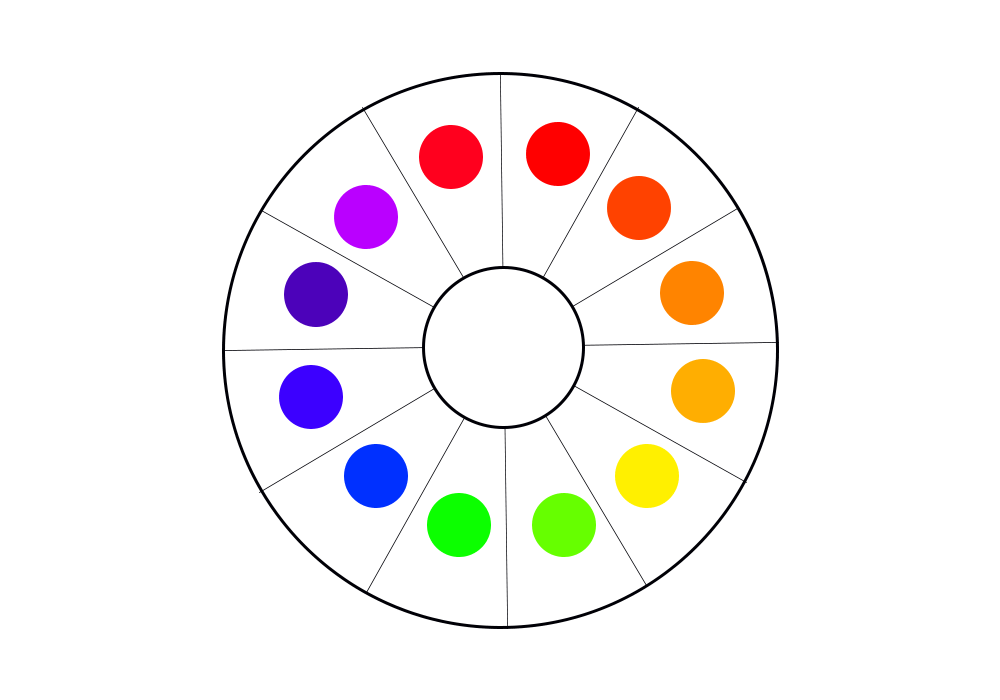
The Color Wheel

The color wheel reflects the primary colors (any color that cannot be made from the combination of other colors), the secondary colors (colors derived from mixing two primary colors or additive primary colors in equal proportions) and tertiary colors (colors derived from the combination of a primary and secondary color in equal proportions).

The color wheel is the foundation of any brand’s color application for design, as well as its brand identity and colors choice; whether you choose to make use of primary, secondary or tertiary colors or other colors that can be derived from the combination of any of these three.
This Includes the use more or less saturation (lightness, with the combination of the white hue and any other color) or more of less value (darkness, with the combination of the black hue and any other color).

Your choice of colors should reflect your brand’s values and the kind of image it intends to project to its target audience.

This is why certain well-known global brands, as well as smaller brand have over time selected specific colors for their brand identity.
As we go through the meaning of some predominant colors, think of well-known brands and why they may have selected certain colors to represent their business.

Below are summaries of some of the most principal colors and their meanings.


The Primary Colors

Red, know to reflect: Passion, energy, love, romance, danger, style, excitement, pain, bravery, active, bold, power, ambition, youthfulness and assertiveness.

Yellow, know to reflect: Joy, cheerfulness, friendliness, intellect, energy, warmth, caution, optimism, understanding and smartness.

Blue, known to reflect: Stability, leadership, trust, responsible, truth, confidence, calmness, tranquility, affection, success, loyalty, authority, peace and sincerity.

The Secondary Colors

Orange, known to reflect: Creativity, productivity, thoughtfulness, warmth, instinct, freedom, impulse, motivation and new ideas.

Green, known to reflect: Growth, clarity, generosity, freshness, life, money, safety, healing, environment, hope, youth and nature.

Purple, know to reflect: Vision, royalty, diplomacy, fashion, dignity, passion, spirituality, luxury, wisdom, magic, plentiful and loyalty.

Other Dominant Colors

Black, known to reflect: Sophistication, power, mystery, death, grief, strength, finesse, subtlety and infinity.

White, known to reflect: Purity, cleanliness, peace, goodness, simplicity, hope, freshness, light and coolness.

Gold, known to reflect: Supremacy, royalty, creativity, warmth, loyalty, friendliness, loyalty and strength.

Silver, known to reflect: stability, authority, security, strength of character and maturity.


Color Use and Branding

After examining all of these colors and some of their generally acceptable meanings. You may be very tempted to make use of a lot of them for your brand representation. This is quite understandable, since many of them reflect some very good and desirable qualities and values.

However, this is not always the smartest route, especially when choosing colors that would in the long run reflect your brand’s values, style, creativity and organization.

Your vision and mission statement for your brand, as well as service offerings should be carefully considered before the choice of brand colors are made, such that your color choices remain pleasing to the eyes and reflect balance.

Below are some formulas that can help you decide on how you could combine certain colors, taking into consideration the color theory rules and application.


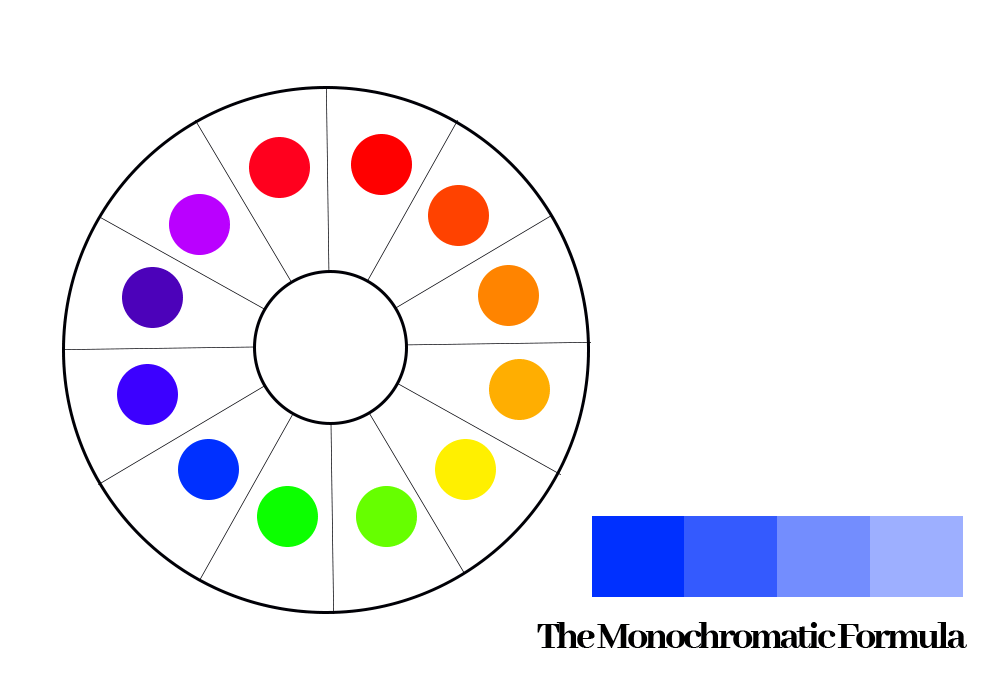
The Monochromatic Formula

This entails that the application of a single hue from the color wheel, with the combination of more or less saturation or value. Say you picked a blue hue.
You would eventually have a variety of that specific shade of blue to be applied consistently across your brand identity, designs and brand assets.

Think of brands you know that may have applied this concept, that would help with more insight.
See the image sample below for better understanding.


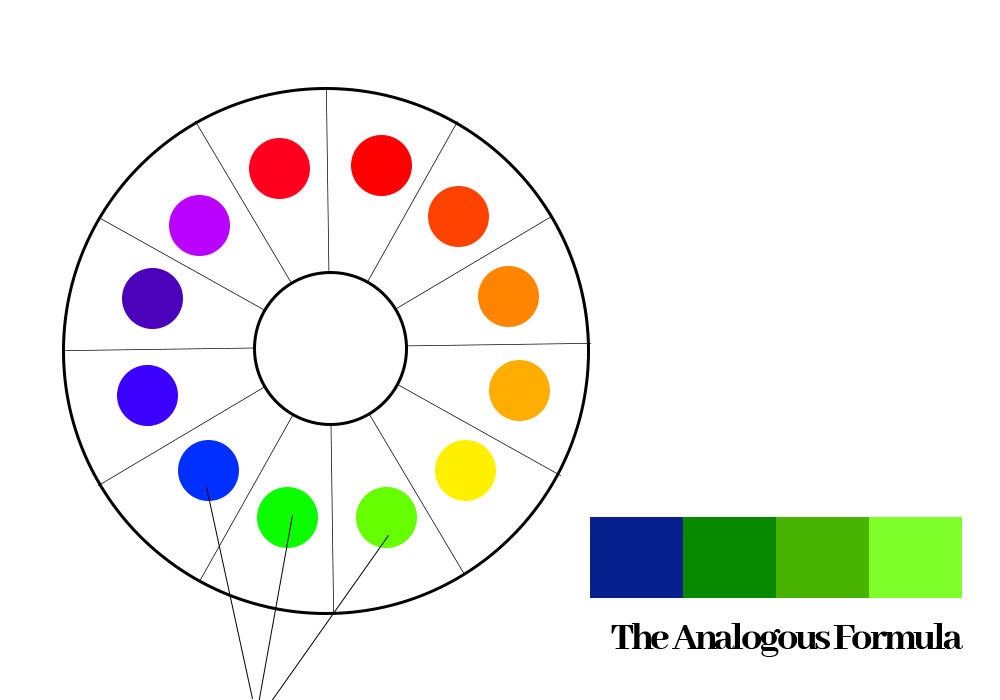
The Analogous Formula

This entails the application of three hues that appear next to each other on the color wheel, with the combination of more or less saturation or value of any of these hues selected.
This gives your brand a lot of creative room for color application and use for your brand identity, designs and brand assets.

Think of brands you know that may have applied this concept, that would help with more insight.
See the image sample below for better understanding.


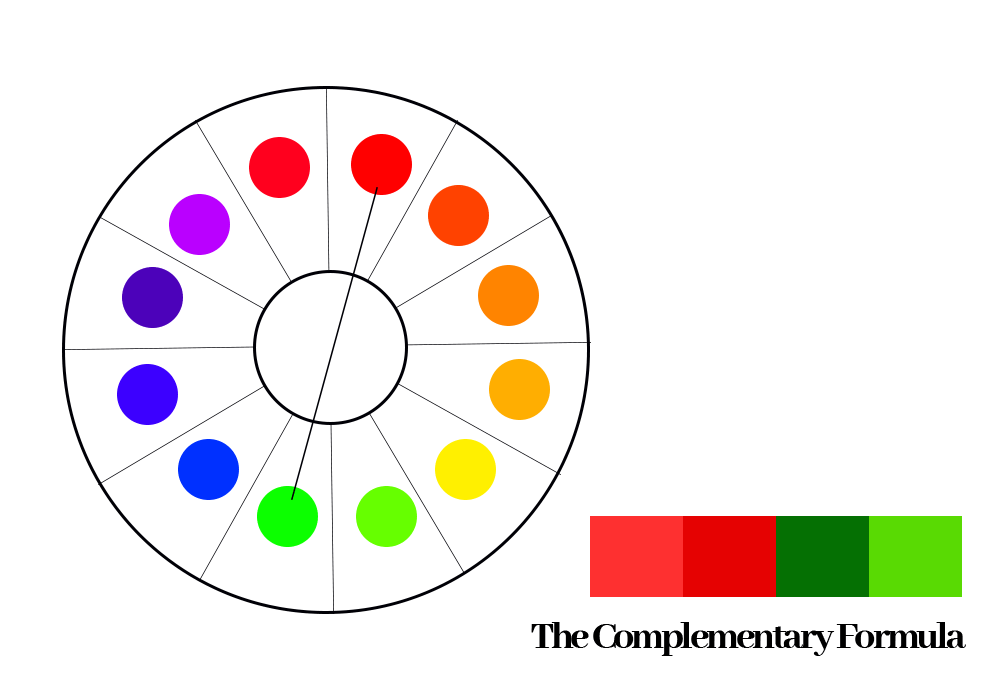
The Complementary Formula

This entails the application of any two colors directly opposite each other on the color wheel with the combination of more or less saturation or value. Say you picked a red hue, the complimentary color for this hue on the color wheel will be the green hue.

You could decide to apply these two selected complementary colors using a specific saturation or value consistently across your brand identity, designs and brand assets.

Think of brands you know that may have applied this concept, that would help with more insight.
See image sample below for better understanding.


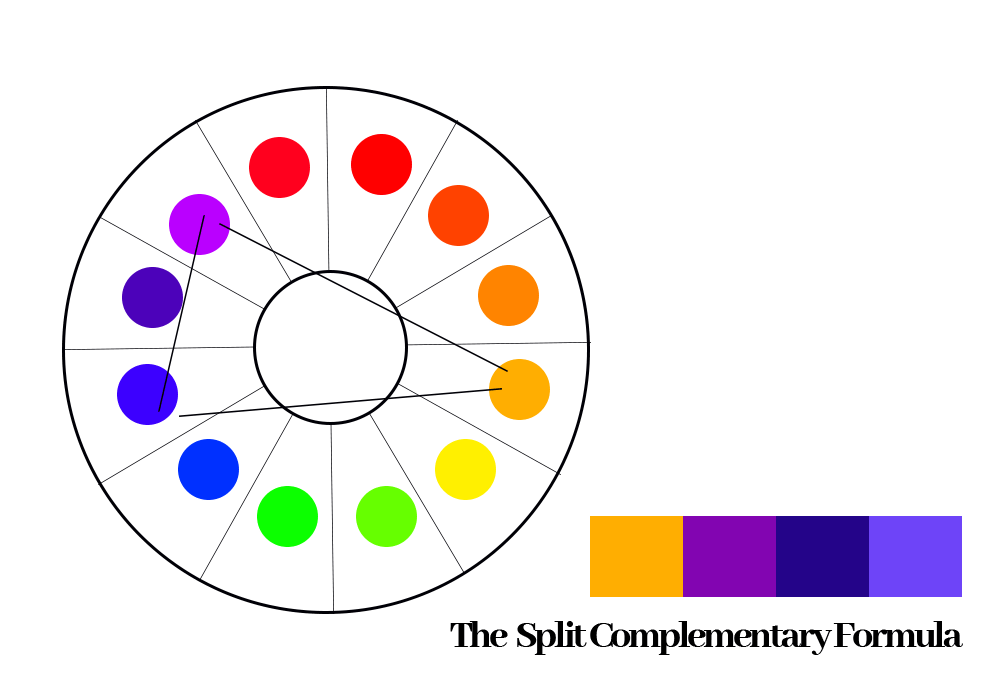
The Split Complementary Formula

This entails the application of any hue on the wheel and two opposite colors to it on the color wheel, with the combination of more or less saturation or value.
Say you picked the orange hue on the color wheel. The split complementary colors for orange would be the green and blue hues.

You could choose to apply these three selected hues using a specific saturation or value consistently across your brand elements, designs and brand assets.

Think of brands you know that may have applied this concept. This should help with more insight and creativity.
See image sample below for better understanding.


The Triadic Formula

This entails the application of any three (3) equally spaced hues from the color wheel, using a triangular method of selection (an equilateral triangle).

This can be a very dicey method of color application, however care must be taken to ensure that the three selections are not hard to the eyes and remain balanced.

This can be achieved by applying more or less saturation or value to the three selected colors.
Think of brands you know that may have applied this concept. This should help with more insight and creativity.

See image sample below for better understanding.


The Tetradic Formula

This entails the application of any four (4) hues from the color wheel, using a rectangular method of selection.

This also has to be selected carefully using a suitable saturation or value of the selected hues and applied across the brand identities, designs and brand assets.

Think of brands you know that may have applied this concept. This should help with more insight and creativity.
See image sample below for better understanding.


Conclusion

Even though these are great formulas that can be followed when creating designs for your brand’s assets or designing in general.

Don’t be afraid to think outside the box or try something new or unique.

Remember, there is beauty in moderation and balance, but there is also a beauty that comes with variety. As long as your choice of colors are balanced and have great contrast, without being hard to the eyes. This ensures that such designs or branding efforts remain attractive, irrespective of your colors choices.

Don’t also be skeptical about nature’s inspirations.

Some of the best designs and color combinations of all time for some brands have been obtained from the natural things around us.

Also remember to generously make use of neutral colors: white, black and grey (using a saturation or value of hue that comes off as most suitable for each design) to bring balance to your all of your branding and design efforts.

We hope all of these information remains helpful in making concrete decisions about your choice of brand colors for your brand identity and design efforts.


Article by Opeolu Adeyemi.
Corporate Communications and Public Relations Consultant
Founder, Brave Publicity Ink!


Posted in Article, Autobiography, Boss Shoes, Business, Career, Entrepreneurship, Risk, Startups, Women

Boss Shoes – The 411 on Making the Tough Call.

So, beginning a journey into the “Boss” life isn’t something anyone just plunges into.
There is always a back story to such a decision and it can be one of the most defining stages of a person’s life.
I for one never really thought about starting something from scratch, at least not seriously and at an early stage.

Most folks would rather work for a few years, gain some momentum in the corporate world, form strong alliances, contribute some value to organizations they have an interest in, make some money and save up for resources before starting out on their own.

I could say I have done that, at least partially (maybe way too early before I was even officially a graduate) and continue to do so (save for the part of making and saving some money).

So, what made me take the entrepreneurial plunge?

Well, I think lots of reasons lead to this decision.
Now, there is a world of difference between what I studied as a Bachelor’s degree and what I currently do, but I will say my pro-bono services lead to wanting more growth and understanding to function and serve better.

I like to do excellent work and when one receives an appointment from an Alma Mater you’ve had a good track record with, it is difficult to take such a responsibility for granted.

Now, there is a world of difference between what I studied as a Bachelor’s degree and what I currently do, but I will say my pro-bono services led to wanting more growth and understanding to function and serve better.

I like to do excellent work and when one receives an appointment from an Alma Mater you’ve had a good track record with, you probably won’t take such a responsibility for granted.


So, I began to research and learn more and soon found this field to be quite interesting.
I leveraged on the first flexible year after college to take an online course that helped me better understand my role. It also led to narrowing down my job applications to specific roles.

I learnt much working for a year with two different organizations and was stretched to the limit (maybe not the limit, but stretched thinly).

Mostly because of the kind of ethics and work culture in this part of the world, many organizations tend to take advantage of employees and sometimes back them into corners. Loading up more and more responsibilities beyond their job descriptions, as was the case for me.

I think this is so because the market place has a big pool of people constantly in search of jobs, so employees are often treated badly by companies with a poor mindset, reflected in statements like, “after all, someone out there is looking for this very job you have”.

A bad mindset and thought pattern, I know.
I think many employees have somehow evolved to become insensitive to the needs of the people they bring aboard their organizations.

I honestly don’t think they set out to be this way or desire to run their companies in such a manner, but experiences (especially bad experiences) change people in leadership.

Things can definitely spin out of control in the work place if bosses do not handle some things carefully and intelligently.

I on the other hand persevered for a while, but when the work experience began to affect my health, mental well-being, my earnings and even my pro-bono services (which were beginning to experience a decline in performance), I knew it was time to go.
So, I quit.
After giving a full month’s notice.

There wasn’t much to look forward to anyway, after all, everyone I had met on my first day had either quit or had been fired and every one I was leaving behind was completely new.
Sad, but somehow, I felt more relieved and at peace with my decision.


So, doing nothing for a while got me thinking, especially with no call back on new job applications.
The ones who did call offered much less pay for more work.

I recall praying a lot to God about things as I thought to myself, what can I do with the skills I currently have?
I couldn’t have had lots of early work experiences for nothing, right?
Or a great result and degree for nothing, right?

So, I did a lot of self-examination about my skill sets, my areas of passion, things that made me restless and I even revisited those childhood dreams I had, even those I used to joke about.

With lots of guidance from God, business conferences and a church conference (one I’ll always remember as long as I live).

I was able to create a business plan, looking beyond my immediate circumstance to what could be.

Not that I had all the resources.
As a matter of fact, I think everything seemed to work against what I had envisioned, my only laptop broke down, relationships that were dear to me went south, everything seemed to go so wrong.
You could say, all hell broke loose.

It was especially hard since I was a long distance away from the comfort of home.
I couldn’t even tell my parents, my mum would only worry and I might have been forced into getting a Job I really had no passion for, maybe a steady one though.

However, deep in my heart, I knew I needed to acquire the relevant skills to succeed in the responsibilities I had and going back home was not an option.
I remember feeling very sad and broken. Lost and quite tired often, but I knew I could not give up.
I learnt to take each day at a time, being content with little, but fanning the flames of the dreams in my heart.

I still made job applications, but got nothing, even though my work experience and academic performance in college was quite outstanding.
However, my next job break would come soon from a very kind stranger at a business conference, one I reluctantly attended, as I was running out of financial resources.

So, when I got the job, I thought to myself, I’ll build this dream along side my steady work. Alas, this was not to be!


I soon found myself working long hours every day and weekends (count Sundays), experiencing long salary delays each month, losing sleep, but pouring in more work everyday round the clock, to say the least.
It soon became another terrible experience.

For someone who depended solely on her earnings and was also a long way from home, it was a hard place to be repeatedly.
I enjoyed my work, but knew I couldn’t stay, especially when I saw no prospects of growth and advancement after much efforts and investment made.

After being patient and persevering, I gave a month’s notice that brought with it a whole month’s work of campaigns that would run after I left. A bad deal yes, but for one who is grounded in doing the right thing always, I knew it was the right way to end my time there.
So once again, I walked away.

It took me some weeks to get back to a normal routine and sleep pattern without waking up early in a state of panic about work that needed to be done, as used to be the case.

So, I went back to my drawing board and decided to just focus, learn and set in place the solid structures required for my Consulting Company, Brave Publicity Ink.

Have I arrived? No.
I’m still on my way.
Do I have all the answers yet? No.

My journey is still rolling out in its early stages, but I’m willing to try my very best, put myself out there and grow something that would one day become a legacy.
A brand that would help, inspire, motivate and empower other people.
A brand that would make the world a better place.

Is “The Life of a CEO” a journey for everyone?
I don’t know.

All I know is, life is full of uncertainties and risks.

We’ve all got to make some hard decisions at different points in our lives, taking calculated risks to move forward, especially if you have a deep desire to make a difference and it remains a burning passion in your heart that you can’t shake off.

You can’t afford to sit back and mope around about how difficult things are when life throws you lemons and rocks. You’ve got to push.
Even when you feel like you’re breaking. You won’t.
You’ll be alright, eventually.


I’m a firm believer in God and my relationship with Jesus Christ is what has helped me weather the difficult times in my life and journey so far.

I know God never leaves us to hang dry, if we will choose to walk with Him and do things honestly and with integrity, even in the hard times.
I believe there is always something you have within you or around you that can make a difference, especially if you are thinking of taking the plunge too.

So, this is my journey so far.
I’m taking things one day at a time, one step at a time and celebrating the small wins, even as I get comfortable in these “Boss Shoes”.


Article by Opeolu Adeyemi.
Corporate Communications and Public Relations Consultant
Founder, Brave Publicity Ink!


Posted in Article, Career, Faith, Strategy, Vision

Article: The Power of Vision!

Vision is the ability to see clearly.
The ability to see beyond the immediate circumstances that surround us to what could be. It is the driving force for anything that would stand the test of time.

It fuels our passions, decisions, thoughts and actions towards the actualization of the things we deeply desire.
Vision is the force behind successful brands.
It keeps the dream alive and propels the dreamer forward in spite of obstacles and challenges.

Without vision, dreams will be lost and dreamers will give up easily at seed time, never pushing through to harvest season to see their visions come alive. Vision fuels the passion and staying power till all is fulfilled.

Vision always precedes structure and content, and the power of vision is strengthened with excellent strategy and consistent execution.

If businesses, brands and people could understand this clearly mapped out principle, then the world would become a much productive and better place.


The Strategy for Vision

Using some Biblical principles and lessons in view of vision, outlined below are some strategies and practical steps.
Principles that can be applied by anyone in the pursuit and accomplishment of their vision, goals and aspirations.


Vision

Why should you work with a strategy when you’ve got a vision?

You should because God is the Ultimate and Grand Master Strategist. His DNA flows through you and you have no choice than to function just as He does.
He set out with a strategy pattern right from the beginning, one we can all learn much from.

Genesis 1:1 says “In the beginning, God created the heavens and the earth.”
Genesis 1:2 says: “The earth was without form and void and darkness was upon the face of the deep.”

What does this mean?
The first statement says heaven and earth were created and then the very next verse says, the earth was without form, it was empty and there was darkness.
Contradictory right? No.

God already saw what He wanted to create right from the beginning.
A complete vision, even though the reality at that moment was emptiness, darkness and the existence of nothing.

Lesson 1:

You’ve got to see the end from the beginning.

Your dreams and aspirations have to be a concluded matter in the eye of your mind.
Many times, when we have big aspirations, the reality around may look like nothing could happen, but once you are able to see and have clarity of Vision, you’ve completed the first phase of your strategy.


Structure

Between Genesis 1: 1-18, we see God get busy with putting things in place be speaking and calling forth things to ensure that there was structure in place.

Lesson 2:

Vision without structure would only make a mess.

Many people, nations and economies could learn from this.
Without proper structures in place, one would end up putting right things in wrong places.
So structure for all things is a very critical next step.

Sometimes, you may not have any resources to put structures in place, but as God’s child, you have His DNA and He is your ultimate resource. In fact, He is resource Himself.

So you speak things into existence, just like your Father in Heaven did at creation. Not just positive declarations or affirmations, but declarations of His promises from His word, the Bible.

As you speak these words, you begin to believe them and it encourages you when faced with obstacles.

Faith or a firm believe comes by hearing and hearing the Word of God. So you have to hear and constantly remind yourself of the truth of God’s Word about you and your future. This propels you to take actions that move you forward.

So make moves in faith, take steps.

This is important because God blesses the work of your hands and not just your words or dreams or desires.
Remember, faith without works is dead. So, make moves to put structures in place about whatever vision or dream you have in mind.

Now, “Structure” can mean different things to different people.
To one it could mean “Finance”, to another “Training” and yet to another “Skill acquisition”.

It could also mean a variety of things like getting “An Education”, “Become an Expert”, “Securing a Physical building”, “Documentations”, “Creating a website”, “Creating an Online Presence” etc.

The bottom line is, you have to be able to identify the structures you need to put in place, structures that would make what you’ve envisioned work smoothly eventually.

Order is critical to the success of any vision and without the right structures in place, trying to accomplish any vision or a goal can easily turn a great dream into something very chaotic with lots of regrets.


Content

Next, from Genesis 1:20-27, we see God begin to fix in the creatures he made into the various structures He had put in place. That’s called CONTENT.
He first created the resources and structures required for their survival, before bringing them in.

Lesson 3:

Vision and structure always precedes content.

So, how does this relate to you?

Well, as you go through your life’s journey, God will place dreams and aspirations in your heart for various purposes and industries.
You’ve got to see it first and believe it. Then work towards making it a reality, putting structures and resources in place first.

For without structures, those you bring aboard your vision could become confused about where you are headed as their leader, or what is expected of them in terms of roles and responsibilities that would help move the vision forward.
So, do things differently.

The above are strategies and life principles, that are applicable to individuals and corporations.
One provided by the Creator Himself, proven over and over again to always work and produce results.

So, what are you waiting for? It’s time for some strategies!


Getting Practical with a Strategic Plan.

Taking into consideration the principle above of VISION, STRUCTURE and CONTENT.
We are sure you’ve realized that for any vision that would stand the test of time with a strong legacy, requires much depth, structures, resources and input from others or a team for success in the long run.

Every vision takes time before it becomes a true picture of itself, but the important thing is to be able to plan efficiently and pace yourself for the long haul.

This implies having a “Strategic Plan” for specific periods that must be evaluated from time to time.

A simple strategic plan should contain the following:

1. Your Vision Statement

This refers to your overall vision as a carefully articulated statement.

An example could be:
“To become Africa’s Leading Pediatric Consultant with a chain of state-of-the-art medical facilities across the African continent, offering prompt and excellent medical services to children.”

The point is, you need to identify the big picture and try to articulate this clearly as a vision statement.


2. Your Action Plan

This should be broken into short-term goals (6 months, a year) or long-term goals (5 years, 15 years or more).
Irrespective of which you choose, your action plan should capture action steps that will help in the actualization of your vision for that period of time.

Still in line with the example above, a short-term action plan for a year under a career category could be to:

“Get into Medical School” and some action steps for this particular goal could include:

*Study for 2 hours daily after each class.
*Ace all courses, especially science courses.
*Graduate with an excellent result in high school.
*Volunteer with medical related organizations during school breaks to increase my extracurricular activities via Internships and volunteer work experiences.
*Apply to win a college scholarship among the top 10 leading medical colleges in the world etc.


3. Your Key Performance Indicators

Also known as KPI’s. This means you need to identify those things that indicate that you are making good progress towards the accomplishment of the goals for your vision.

Your KPI’s using the example above could include some of the following:

* Studying and understanding better my subjects after each school day.
*Obtain an A grade in all courses especially my science courses.
*Successful internship with a medical nonprofit at the end of my summer break.
* Securing at least 5 medical school scholarship offers at the end of my school year etc.


4. Your Accountability Resources

This means identifying those things or people that will help keep you accountable for accomplishing your goals in view of the vision set.

This could include:
Family members, mentors, teachers, friends and people you can really trust.
It could also mean the use of technology and tools such as your mobile phone for keeping a schedule or setting reminders that help you stay organized and keep you on track daily.

Usually a schedule or tool that helps you identify things you need to do, friends or people that you can partners with in achieving some action step such as “studying daily” etc.

We hope you get the idea, and all of this should ultimately help you make steady progress daily.


Conclusion

Your strategic plan does not have to be detailed to the T, but should only help enhance your productivity in the accomplishment of your goals and overall vision.

It is however important to stay flexible, as sometimes our plans are influenced by external factors, changes and challenges.
In such moments, you must think productively about what can be done to move forward in accomplishing your vision, instead of staying stuck.

As long as you have the vision within your heart and believe in it, your actions, decisions and steps will automatically flow and align towards its accomplishment, until it is done.


The Brave Planner Tool

Now, if putting together a strategic plan would prove to be too much of a task for you, not to worry! We have just the right tool for you, called the “Brave Planner Tool” designed and created by Brave Publicity Ink.

This tool is available at our online store.
It is a ready-made and easy to use tool. It can be customized to help you get more organized in crafting and putting together a compelling and actionable strategy for your vision!


Article by Opeolu Adeyemi.
Corporate Communications and Public Relations Consultant
Founder, Brave Publicity Ink!