Posted in Publicity Posts

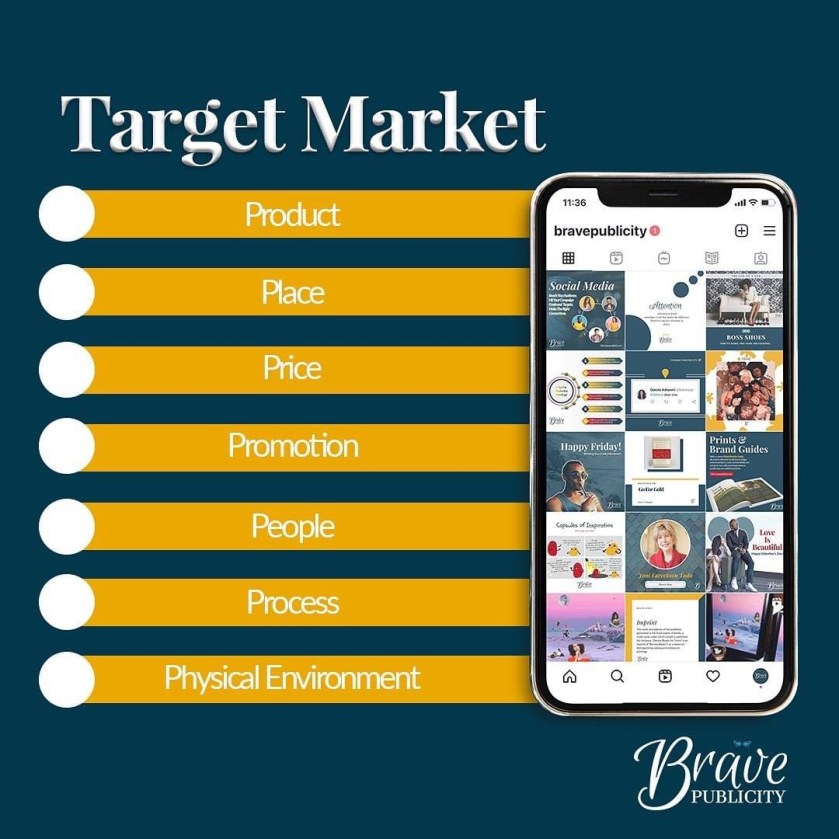
Target Market: The 7Ps.

An effective digital marketing strategy is hinged on the ability of strategists and business owners to clearly define their target market.

In doing this, you’ve got to think about the 7P’s = Product, Place, Price, Promotion, People, Process and Physical Environment.

Without clarity about the 7P’s, you may have a great idea, product or service but find yourself driving publicity for a wrong market, using the wrong mediums or communication assets for your brand.

Implementing the right strategy on the right medium or communication asset is key.

Let’s help you get started with your PR and marketing needs today!

Brave Publicity is a design centered Corporate Communication, Public Relations and Publishing Consulting Agency, with specialty in Design, Video Edits for Digital Marketing/Brand Management, Branding and Prints.

To get started, reach out to us using the details on our home page, https://bravepublicity.com
Follow @bravepublicity for more updates!

Posted in Publicity Posts

Difficult Conversations Are Important!

Difficult conversations test our level of maturity and gives us the opportunity for clarity from communicating.
Helping us separate facts from assumptions, reality from emotional reactions and falsehood from truth.

Difficult conversations often requires a level of vulnerability and this is the reason why many run from or avoid them.
Difficult conversations also require deliberate actions, sometimes not in favor of or to the satisfaction or comfort of the concerned parties. So many avoid them.

It is better to be decisive after a clear assessment of a situation, than to be on the fence of decisions. With difficult conversations, one must be willing to take responsibility.

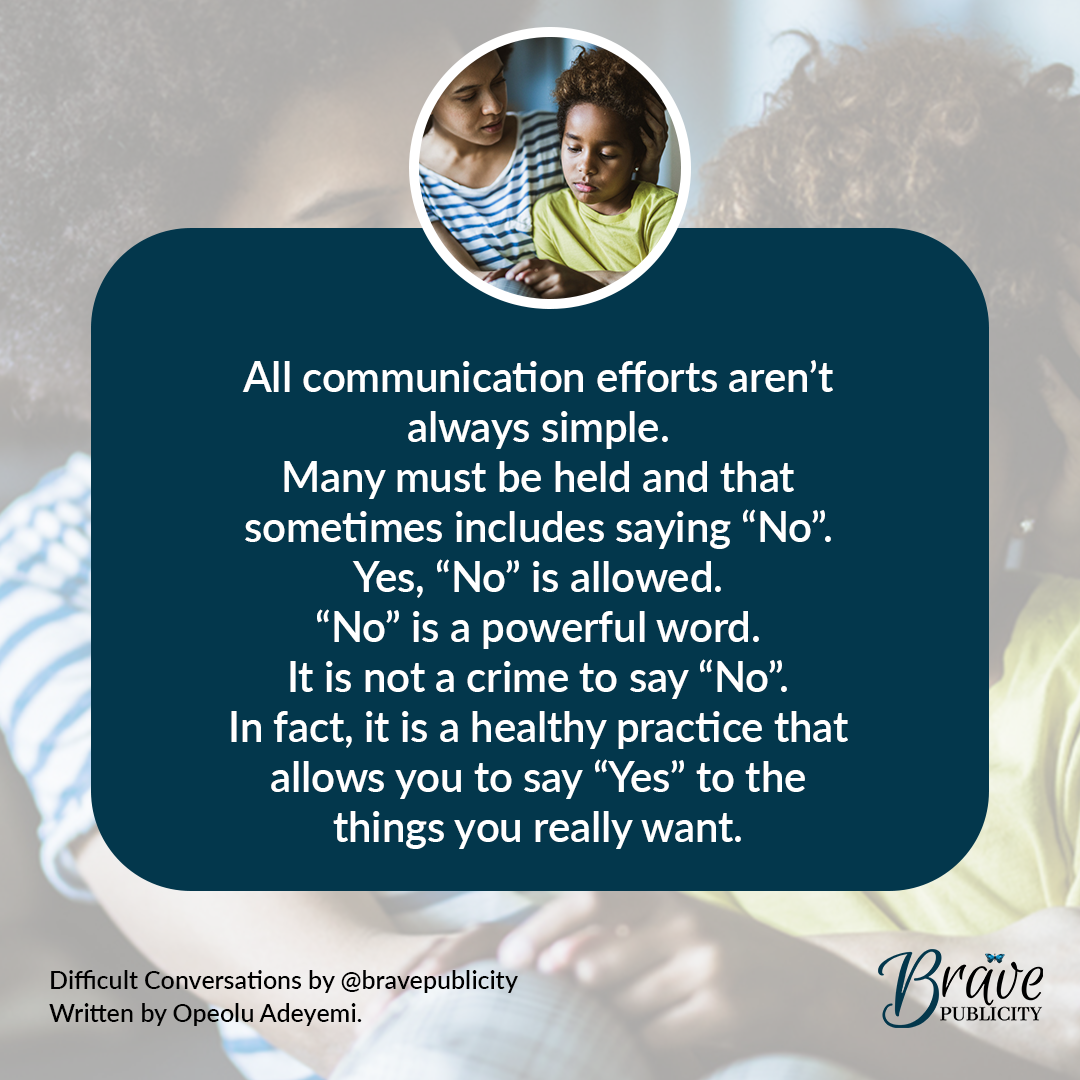
All communication efforts aren’t always simple.
Many must be held and that sometimes includes saying “No”.
Yes, “No” is allowed.
“No” is a powerful word.
It’s not a crime to say “No”.
In fact, it is a healthy practice that allows you to say “Yes” to things you really want.

Having difficulty conversations is important, and saves one from undue stress and more complex problems. So, be willing to become open, vulnerable, precise, clear and intentional.
Have you ever watched a soap opera unfold and wished many times that a character had just spoke up about something from the onset?

You probably wished a thousand times that they had been brave enough to have that “Difficult Conversation”.
A communication effort that would have saved everyone from a whole lot of complex problems.

Yet as you watched the movie unfold, you really wished that they had been brave enough and decisive.

However, there was really nothing you could do about it.
Unless, they made a choice to have that difficult conversation. You knew without a doubt that, things could only get worse.

In life it’s the same for us.
So, stop running away from difficult conversations, just because they make one feel uncomfortable for a while or can cause a person to feel upset.
Effective communication requires having those difficult conversations.
Be brave!

Posted in Publicity Posts

Dream and Rise Giant!

Whatever you hope to accomplish, keep taking steps and keep investing in what really counts for you.

Creating the “Dream and Rise Giant” design and merchandise remains one of my highlights so far as a business owner.

An enjoyable experience and milestone. It represent growth, loads of hard work behind the scenes and being able to rise above challenges.

I hope you love these prints by @bravepublicity, as much as I do.

We have currently in stock:

1) Portraits.

  • Large Frames – (18 x 24), Price: N20,000 ($40)
  • Small Frames – (8 x 10), Price: N7,000 ($15)

2) Mugs, Price: N1,500 ($5)

3) Towels, Price: N5,000 ($10)

Visit the shop section on our website: bravepublicity.com/shop/ to place an order!

For further inquires, send us a DM (using the contact details on the web below or on the home page).
You can also reach out via our social media platforms).

Posted in Article, Corporate Communications, Digital Marketing, Marketing, Public Relations, Publicity, Strategy

Article: Brand Appraisal

Appraisal is a very important phase for strategy improvement and implementation in the field of corporate communication and public relations.

It helps publicists and communications specialists define accurately action steps and improvement opportunities required for a brand or business to achieve certain milestones or success.

In light of the present-day communication assets and innovations, a number of things define brand appraisal for Corporate Communications and Public Relations.

  1. Present-day Communication Assets Utilized.
  2. Growth Strategies and Impact of Communication Assets.
  3. Relevance of Communication Assets and sustainability.
  4. Ranking and Search Engine (Optimization and Marketing).
  5. Brand Name, Brand Positioning, and Impression.

Let’s explore some more, these five (5) areas:


Present Day Communication Assets Utilized.

One of the first steps for towards “Brand Appraisal” is identifying the current communication assets being utilized by the brand.  You’re most likely to find the following:

  1. Zero utilization of present day communication asset. This is so, for those who just love to do things the old fashioned way and are averse to change, new methods and trying new things. Such brands most likely have a physical outlet and marketing is done through word of mouth and physical exchange of products or services.
  2. Some utilization of present day communication assets. This is so for some brands who have some level of exposure to the importance of establishing some communication assets such as an official email, an online presence for the brand or a simple website.
  3. Full utilization of the present day communication assets. This is the case for brands that recognize the importance of establishing communication assets and strongly utilizing them.

The appraisal here means determining for each of these three categories, if the chosen communication assets are suitable and relevant for the brand. As this affects greatly the growth and impact of the brand, leading us to the next point.


Growth Strategies and Impact of Communication Assets.

The second step towards “Brand Appraisal” is assessment for growth and impact.
In terms of communication and public relations, one needs to determine how strong an online presence is and how visible the brand is to the public.

Things like the online presence across key communication assets, the follower count, the visibility of the brand, and the level of engagement for created content etc. All are important aspects to consider.
Rich engagements ultimately determine the reach for brand awareness and potential of great content going viral.

In terms of communication, this determines if a brand is doing well enough to reach the target audience.

So you need to ask growth and impact questions like:

  1. How strong is the brand’s online presence?
  2. Is the brand well represented across the relevant and key communication channels?
  3. Is there more awareness of the brand presence, growing across the key communication assets?
  4. What’s the follower count across the key communication assets, in relation to the time of brand takeoff?
  5. What’s the level of engagement by people across the key communication assets? Inquiries, Collaborations, Comments, Shares, Saves etc.
  6. What percentage of sales can be attributed to communication, advertising and marketing efforts across the communication assets?

Relevance of Communication Assets and Sustainability.

The third step towards “Brand Appraisal” is assessment for relevance of the selected communication assets. This is based on the brand focus, the uniqueness of each communication asset and it’s use by the brand.

Case Study: A Fashion Brand

Take for instance, a fashion brand, a great communication asset for great publicity would be one that aids visualization and ease of purchase. Some options for communication assets that would be a good fit for such a brand should be one that enhances clarity, simplicity and aesthetics.

A good match would be a website and social media platforms like Instagram for great images/ videos and TikTok for videos which showcases the variety of fashion items.
The choice of content presentation would often vary for fashion brands.

A brand’s budget often determines the approach. Sometimes, brands operating on a cost effective budget may rely on great “Design” (graphics, animation and videos) and “Marketing” using actual products and mockup designs of same. Another popular option with a wider budget for marketing and advertising is the engagement of influencers and models who showcase such fashion pieces or items.
So the Short videos on Instagram, Longer Videos on IGTV, Instagram reels and TikTok videos become instrumental for content creation in this regard.

Of course, other communication assets such as Facebook and Twitter and other internal communication platforms for email conversations and email marketing may be useful in the long run, however prioritization should be for the most relevant asset that aids publicity and gives the fashion brand better awareness that ultimately drives growth and sales.

This also implies that relevance and choice of communication asset for brands across different sectors will vary. This is a choice that needs to be carefully decided when prioritizing the relevance of a communication asset for a brand.


Ranking and Search Engine (Optimization and Marketing).

The fourth step towards “Brand Appraisal” is assessment for ranking and search engine optimization for the brand. How often does the brand show up on the web while surfing the web for key things pertaining to the brand’s industry, niche or area of focus?

To address this, it’s important to ask the following questions:

  1. How optimized is the brand’s website?
  2. Can the brand be easily found when searched for on the web?
  3. Is the website adapted for both mobile and web, thus aiding the user experience?
  4. Is the brand’s web content crafted to include relevant keywords for its line of business, including Broad Match keywords, Phrase Match keywords and Exact Match keywords that ultimately aids search for the brand’s industry?
  5. How often do Search Engines recognize that the website has relevant content for search?
  6. How high up in terms of ranking, does the brand’s website appear in search?
  7. Does the brand need to drive some search engine marketing efforts for better visibility?
  8. Are there any local listings that aid search for the brand’s visibility?

These are questions that need to be answered in view of appraisal for Ranking and Search for the brand.

When a brand/business is willing to set aside a budget for Search Engine Marketing (SEM) / Advertisement efforts, then visibility for search can be worked upon.
What ultimately drives the success of visibility for search is the “Bid” (maximum amount an advertiser is willing to pay for a click on an ad) for SEM efforts and the “Quality” of content on websites. 
So, search engines look at these two things before prioritizing content they show to users; those they think are most relevant to the search in question by users.

Optimization efforts and local listings on platforms like “Google My Business” can also be very useful for small businesses/ brands that can’t afford a budget for SEM efforts and advertisements to aid search.

However, it’s very possible to achieve great visibility with Search Engines over time for a niche, an industry or a line of business. This is achievable when relevant content/details are shared often and consistently regarding the area a brand intends to dominate or become relevant.


Brand Name, Brand Positioning, and Impression.

Finally, the fifth step towards “Brand Appraisal” is an assessment for brand’s name, brand positioning and impression.

Some questions to ask for this include:

Is the brand name reflective of what they do (the core area of focus, niche or industry)?
Is it memorable and easy to pronounce and recognizable amongst other brands?
Does it stand out from similar brands?
What do we (brand owners/ strategists/ publicists) want people to know this brand for (for new brands)?
What have people come to know this brand for, or what area, industry or niche do people associate this brand with?
Are people’s interpretation of what the brand stands for accurate?
Are those impressions positive?
What are people saying about the brand?
What does analytics for the existing communication assets say about the brand?
How can we work on the improvement opportunities based on the data obtained from these assessments or analytics?

These are some of the questions that can be addressed to decipher if a brand has the right name, impression and is positioned accurately in the market place.


Remember, data driven decisions are always relevant for growth and improvement for brands, and when one is willing to listen and learn from the information obtained from the appraisal of brands, then a great strategy can be drafted; aimed towards growth, development, brand visibility, brand reach, engagement, impact and ultimately sales.

Thank you for reading.


Article by Opeolu Adeyemi.
Corporate Communications and Public Relations Consultant
Founder, Brave Publicity Ink!


Posted in Article, Business, Career, Leadership, Self development

Article: Effective Communication

Friendships, relationships, businesses and communities are built on communication. Without the ability to communicate, the world will be in disarray, filled with much misunderstanding, breeding loneliness and possibly the exasperation of being misunderstood or judged wrongly.

Effective communication is what makes systems, structures and our relations with others work out smoothly. It is an essential factor for long lasting relationships.
It is such a powerful skill that aids conflict resolution, strengthens bonds between nations, people, and changes the perspective of long standing disputes and disagreements between people or communities.

Life circumstances become better as a result of effective communication. However, the application of this very essential soft skill is based on established understanding and relevance, a skill not many have mastered.

When the value of a skill is established, only then does it appeal to those in need of it. This is so about effective communication.

Does it really hold that much value?
Can it be obtained and mastered by all?
Does it really have the power to resolve conflicts and end long standing wars?

What does “Effective Communication” really mean?

To put to rest some of these questions, let’s explore the definition and attributes that make up the phrase, “Effective Communication.”


Let’s begin with the word ‘Communication’.
‘Communication’ means to exchange information through speaking, writing or some other form of medium. It is also the act of conveying meanings from one entity or group to another, through the use of mutually understood signs, symbols, and semiotic rules.

‘Effective’ means to reach an optimal level, a peak of excellent delivery or performance.

In order words, ‘Effective Communication’ means, exchange of information between parties at an optimal level, where the entities or groups involved have mutual understanding of what is being conveyed and can respond accordingly.

So, effective communication is only established when all parties involved are able to create mutual, accurate and clear understanding of what is conveyed.


Some defining attributes make this possible and without them, it is often impossible to have effective communication and they include these four broad features: Conversation, Sound, Cues and Action.

Let’s examine each of them for more insight.

Conversation

To establish excellent or effective communication. The conversation or message being conveyed needs to be understood by both or all parties involved.
A conversation that is one sided with decisions being set in motion by one party, is an enforcement, not a mutual agreement. Both or all involved must have mutual understanding of the dialogue.

When this is absent, effective communication cannot be achieved and this involves active and attentive listening. This means, listening to respond accurately to the message being conveyed, not just listening to speak in turn.

This is a challenge for many people and organizational leaders, and so the result is, effective communication is never established, breeding dissatisfaction with all involved in the conversation.

In a dialogue, the focal point, challenge or objective must be identified and acknowledged by all involved and then satisfactory solutions and actions can be established.
This is only possible when attentive and active listening is put in play, when conversations and meetings are held.


Sound

Sound gives meaning to a message and strengthens conversations. It is essential in establishing excellent or effective communication, when used appropriately. Sound in terms of the ‘Voice’ and ‘Tone’ of a message, whether spoken, written or conveyed via art or creativity.

The established tone or voice can ultimately determine the meaning of the message being conveyed. It could be deciphered as either compassionate, hostile, mild, suggestive, derogatory, exhilarating, cheerful, gloomy, heated, commanding, weak, strong, assertive, guarded and the list goes on.

Many people, institutions, nations or communities have been able to establish excellent or poor communication, hence developing amazing or terrible relationships as a result of the choice of voice and tone.

This is very critical factor, as interpretation of conversations are often made based on the perceived tone or voice by the conveyor of any message.

Also many great writers have gained mastery of this very important skill in the act of communication, artistically infusing the appropriate voice and tone with their words, creating excellent publications across a genre of books that have stood the test of time and have attracted great readership and rewards.

The ability to identify the appropriate tone or voice for use in various dialogue circumstances or deduce what is being received from others, ultimately helps one understand accurately any conversation. It also helps one identify improvement opportunities for effective communication in active discussions or feedback.


Cues

Cues are so essential in communication and they include verbal and non-verbal cues. These can be easily decrypted from time lapses and body language.

Time lapses, a pause in a conversation, verbal or written (a presence of silence for a period or a written symbol for a dialogue expressed in written words) is often indicative of something, usually an impression or meaning the conveyor wants one to decipher.

Such time lapses could mean disinterest, disregard, a plea for understanding and reconsideration, fear, anger, permission to hear out the other person or party, a gentle nudge towards reflection or appraisal, etc. regarding an already established dialogue or an on going conversation.

Time lapses are typically applied to strengthening an impression regarding information that has already been laid bare by a conveyor.  That pause or silence often carries a weight and has meaning in an ongoing conversation.

In the same vein, the body language of a conveyor or the parties involved also expresses and strengthens the meaning of a message, often combined with or without voiced expressions.

The body language may express, pain, weariness, passion, anger, joy, excitement and a variety of emotions that eventually makes a conveyed message more accurately deciphered.

The entire context and content of such conversations enables one to identify differences and the real meaning that should be deduced from such a dialogue.


Actions

For effective communication, one of the most credible ways of deducing if a dialogue has reached a point of mutual understanding by both parties is by the actions that follow.

If the actions that follow are satisfactory and correspond with the resolutions and agreement by all parties or the conveyor of a message in a dialogue, then one can say that effective communication has been established. If not, what may ensue is a lot of friction and resistance.

Many times, individuals pay attention to only what is being said, without paying close attention to the actions that follow as well. In corporate environments as well as social circles, this plays out all the time. When one pays close attention to actions that follow any conversation, then one can understand accurately what is being communicated.


However, it is important to note that these four (4) highlighted features work in harmony and the application or interpretation of just one or some from an active discourse may lead to wrong conclusions regarding a message or due to poor communication.

But when all of these features are applied in sync, it helps in accuracy, clarity, mutual agreement and ultimately, effective communication.

I hope you found this article to be insightful and helpful.
Thank you for reading.


Article by Opeolu Adeyemi.
Corporate Communications and Public Relations Consultant
Founder, Brave Publicity Ink!